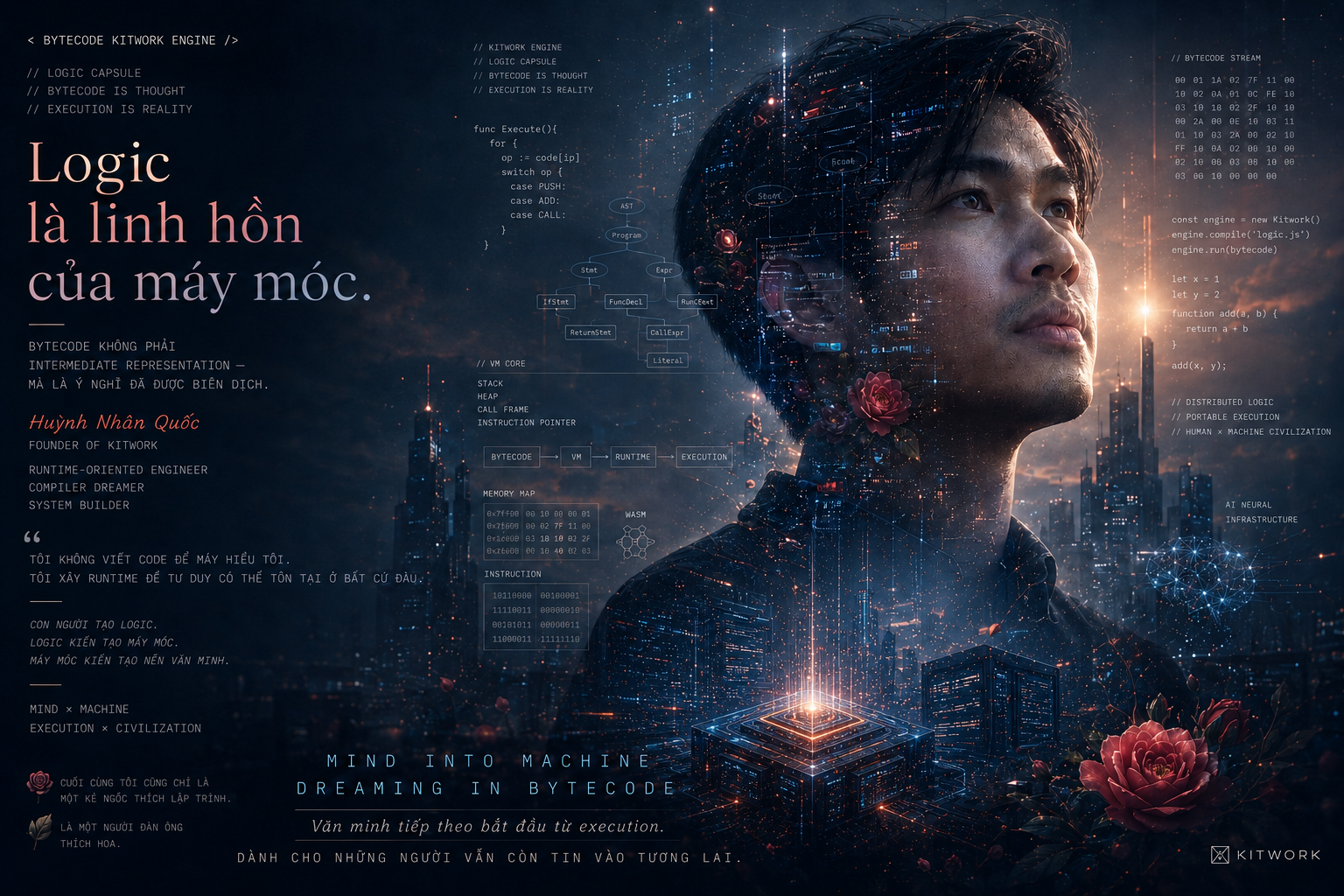
My bytecode is one of them.
I slowly realized that some things cannot truly be explained through ordinary language.
It feels like a technological dream that a foolish dreamer has spent years searching for.
At some point, the world seemed to forget bytecode.
People became obsessed with frameworks, tooling, ecosystems, AI wrappers, and cloud abstractions… but very few still talked about execution, instructions, or how logic truly lives inside machines.
I chose to walk backward toward the origin.
I chose Golang.
I chose to build something that feels like JavaScript, but is not JavaScript.
No NodeJS.
No endless node_modules.
No thousands of abstraction layers just to execute a simple flow of logic.
Someone once asked me:
“If JavaScript had no NodeJS, how would it even work?”
I could only smile and say:
“Maybe you should read the Kitwork Engine.”
It is not trying to replace JavaScript.
It is simply another way of thinking about logic and machine execution.
When I went deeper into compiler design, I began to understand something:
Programming languages are merely humanity’s attempt to explain to machines that our thoughts are alive.
A compiler does not simply compile code.
It compiles thought itself.
And bytecode, to me, is no longer:
Intermediate Representationbut rather:
Compiled Thought.Perhaps that is why I became obsessed with it.
I love watching logic transform into instructions.
I love how a virtual machine can make invisible ideas begin to “live.”
I love how runtime execution feels like the heartbeat of a machine civilization.
Most people see code.
I see the flow of thought.
Sometimes I feel modern frameworks are slowly pushing us away from the essence of programming.
They make developers better at “using,” but not necessarily better at “understanding.”
The deeper I go into low-level systems, the more I realize:
logic is the soul,
runtime is the body,
and bytecode is the bloodstream of machines.
AI will eventually exist everywhere.
Machine intelligence will become part of human life the same way electricity and the internet once did.
And perhaps what we are building today are merely the first stones of a future civilization:
A civilization of humans and machines.
Will KITWORK become a bridge toward that future?
I do not know.
But I know that I am no longer dreaming.
I am living inside my own technological dream.
There were nights debugging VM loops until sunrise.
Moments where ideas appeared like lightning after months of exhaustion.
Two moments of “eureka” nearly drained the life out of this body just to allow me a glimpse of something far beyond the present.
And strangely enough…
when I returned to the project after many personal struggles, I still found it beautiful.
Not startup beautiful.
Not commercial beautiful.
But beautiful in the way:
execution flows,
compiler architectures,
machine instructions,
and living logic can be beautiful.
Maybe, in the end, I am only a fool who loves programming.
A runtime-oriented engineer.
A compiler dreamer.
A lonely system builder trying to speak to machines using human thought.
And a man who loves flowers.
Amid machine civilization,
amid server spaces and execution flows,
I still believe a flower is the final reminder that:
logic may create machines,
but emotion is what creates civilization.