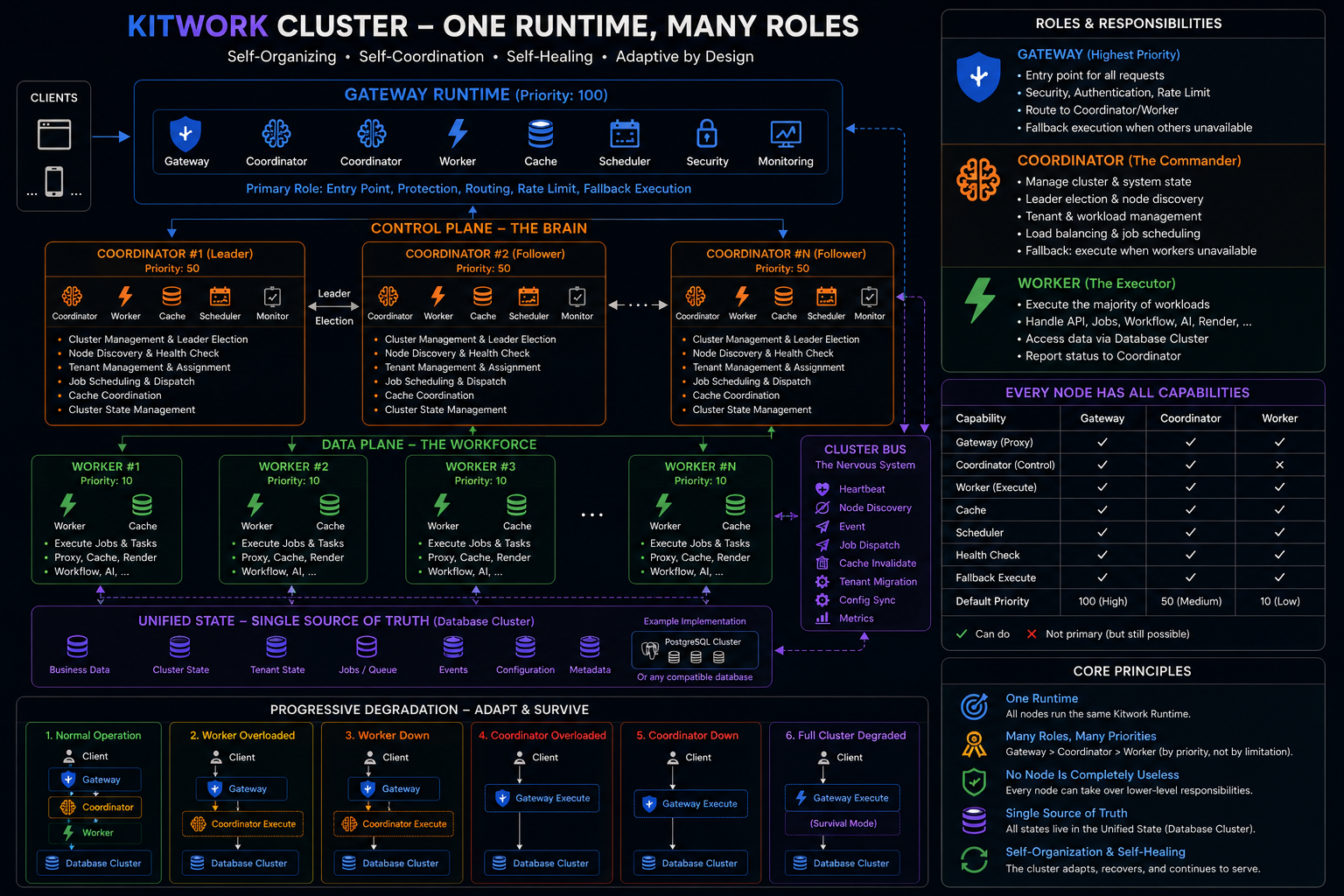
As a platform grows
As a platform grows, we naturally start adding more technologies:
Redis for caching
RabbitMQ for queues
Kafka for events
Consul for service discovery
Nginx for gateways
Each technology solves a specific problem extremely well.
But when combined together, they often create a system that becomes increasingly difficult to understand, maintain, and operate.
At some point, I began asking myself:
Can we build a system where every component is born from the same philosophy?
That question became the foundation of Kitwork Cluster.
One Runtime
In Kitwork, there is no such thing as:
Gateway Server
Cache Server
Queue Server
Worker Server
There is only one thing:
Kitwork Runtime
Every node in the cluster runs the same engine.
Every node is capable of:
Execution
Caching
Proxying
Workflow Processing
Scheduling
Event Handling
Queue Processing
The only difference is role priority.
For example:
Gateway Runtime
Coordinator Runtime
Worker Runtime
These are not different server types.
They are simply different responsibilities assigned to the same Runtime.
Database Cluster – The Single Source of Truth
The entire cluster trusts one thing:
Database Cluster
It stores:
Business Data
Cluster State
Tenant State
Jobs
Events
Metadata
Configuration
The database is not merely a storage engine.
It is the collective memory of the entire platform.
Any Runtime may fail.
Any Runtime may be replaced.
But the state of the system remains intact.
That is why every node ultimately revolves around the same source of truth.
Gateway – The Guardian
In most modern architectures, a gateway is little more than an entry point.
It receives requests.
It forwards requests.
And usually does little else.
In Kitwork, the Gateway is the first line of defense.
Its primary responsibilities include:
Routing
Authentication
Security
Rate Limiting
Load Balancing
However, the Gateway is not just a proxy.
If Coordinators become unavailable.
If Workers become overloaded.
If the entire cluster is under pressure.
The Gateway can step in and execute workloads itself.
It is the platform’s final survival layer.
Coordinator – The Commander
The Coordinator is the brain of the cluster.
But it is not a proxy.
It is not a mandatory hop for every request.
It is not a bottleneck.
The Coordinator exists for one purpose:
System Orchestration.
Its responsibilities include:
Leader Election
Node Discovery
Health Monitoring
Tenant Assignment
Job Scheduling
Cache Coordination
Cluster State Management
The Coordinator knows:
Which nodes are alive
Which nodes have failed
Which nodes are overloaded
Where tenants should reside
Which workloads should be assigned next
It does not fight.
It commands.
But when necessary, it can step onto the battlefield itself.
Worker – The Executor
Workers are where value is created.
This is where the actual work happens:
API Processing
Rendering
Workflow Execution
Job Processing
AI Inference
Business Logic
Under normal conditions, the majority of requests are handled by Workers.
They consume most of the resources.
They generate the final outcomes users interact with.
Workers are the workforce of the platform.
No Node Is Completely Useless
This is perhaps the most important principle behind Kitwork.
In many systems today:
Node A fails → System degrades.
Node B fails → System degrades.
Node C fails → System degrades.
Kitwork takes a different approach.
Every Runtime can assume the responsibilities of lower-priority Runtimes.
For example:
Gateway can become:
Gateway
Coordinator
Worker
Coordinator can become:
Coordinator
Worker
Worker can become:
Worker
This means:
No node becomes completely useless simply because another node fails.
Progressive Degradation
Rather than pursuing perfection,
Kitwork is designed for survival.
Normal Operation
Gateway → Coordinator → Worker
Worker Overloaded
Gateway → Coordinator Execute
Worker Unavailable
Coordinator takes over execution
Coordinator Overloaded
Gateway Execute
Coordinator Unavailable
Gateway takes over
Severe Cluster Failure
Gateway can still communicate directly with the Database Cluster
Performance may decrease.
But service availability remains.
The system continues to operate.
Cluster Bus – The Nervous System
To coordinate Runtime communication, Kitwork introduces the Cluster Bus.
The Cluster Bus carries:
Heartbeats
Elections
Job Dispatches
Cache Invalidations
Tenant Migrations
System Events
Configuration Synchronization
It acts as the nervous system connecting every Runtime into a unified organism.
Every Runtime can listen.
Every Runtime can respond.
Every Runtime can participate in the life of the cluster.
The Ultimate Goal
Kitwork is not trying to become another framework.
Nor is it trying to replace every existing technology.
Its goal is to build a platform capable of:
Self-Organization
Self-Coordination
Self-Healing
Self-Adaptation
Where:
Every node is a Runtime
Every Runtime can execute
Every Runtime can support others
Every Runtime serves the same mission
And all of them trust a single source of truth:
Database Cluster
Because a strong system is not a system that never fails.
A strong system is one that continues to operate when failure inevitably occurs.