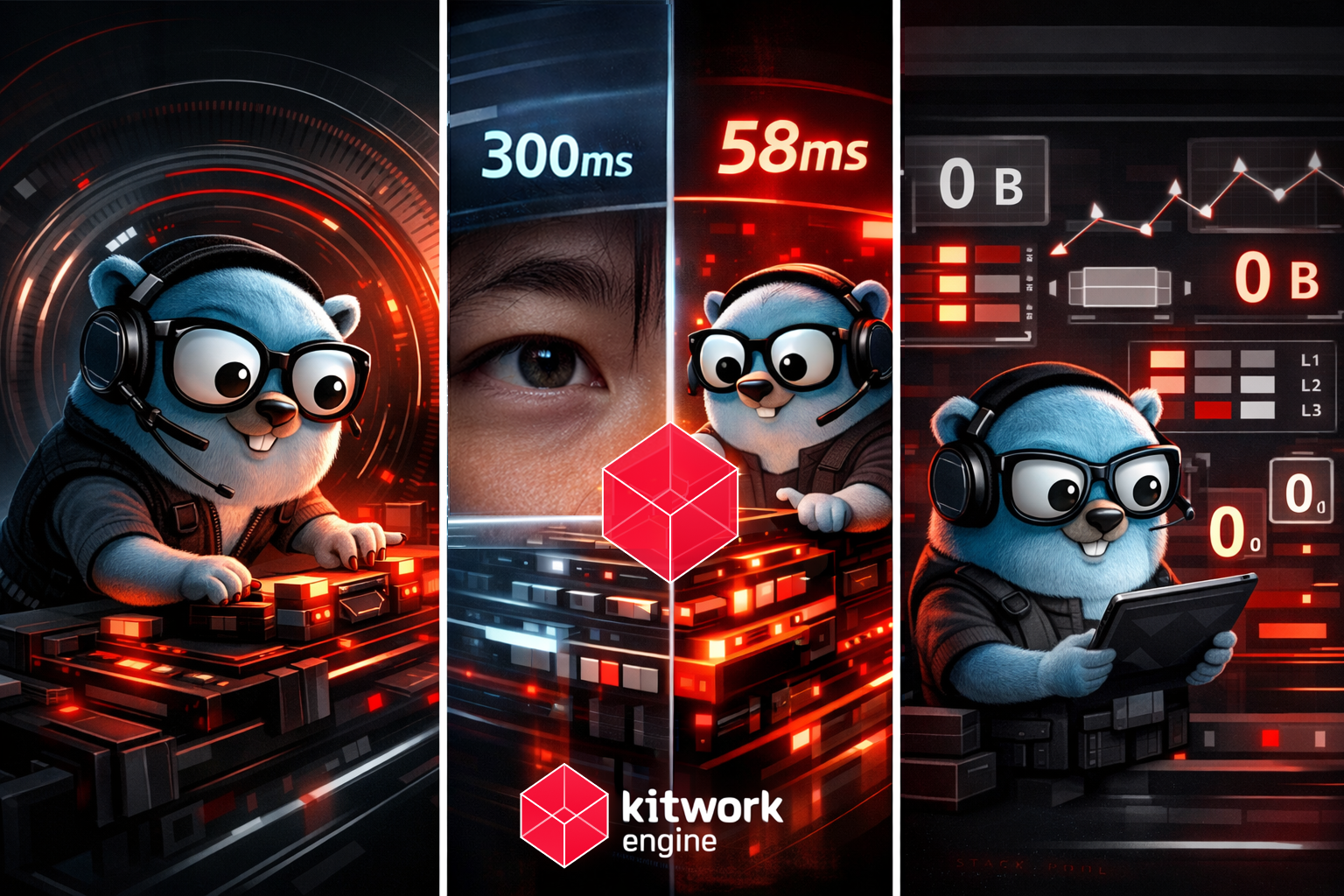
The Art of the Nanosecond⚡️🔥
“A screenshot doesn’t mean anything. It’s just virtual numbers.”
That comment ended the discussion.
Instead of arguing, I opened the profiler.
What followed was not optimization it was open-heart surgery on the Kitwork Engine: dismantling the execution loop, reworking the stack model, and rewriting the VM’s core assumptions down to the bytecode level.
The result:
1,000,000 operations executed in 58ms (0.058s)
A 20× speedup, pushing a Go-based virtual machine close to its physical limits.
Defining the 58ms Threshold ⚡️🔥
58 milliseconds is invisible to humans.
To a high-frequency system, it defines an entirely different performance class.
Human blink: ~300ms
→ In a single blink, Kitwork executes ~5,000,000 instructions.Finger snap: ~150ms
→ Nearly 3 million operations completed before the sound propagates.
At 17,000,000 internal ops/sec, this stops being a discussion about “fast software.”
It becomes a discussion about reaction-time systems.
Under the Hood: The Engineering Decisions That Made It Possible ⚡️🔥
Achieving this throughput while maintaining Zero GC (0 B/op) required abandoning conventional interpreter design patterns.
Here’s what changed.
1. The Death of map[string]interface{}
Most scripting engines rely on hash maps for variable storage.
That convenience comes with a cost: hashing, pointer chasing, and heap allocations.
Kitwork’s approach: Static Slot Allocation
During compilation (AST → Bytecode), every variable is assigned a fixed integer slot.
At runtime, values are accessed through a flat slice.
Result:
No hashing
No dynamic lookup
Constant-time access with cache-friendly memory layout
2. A Pure Stack-Based VM
Rather than emulating object-heavy runtimes, Kitwork commits fully to a pre-allocated value stack.
PUSH / POP / STORE operate on a contiguous memory region
Custom
Valuestructs minimize pointer usageData stays hot in L1/L2 cache, avoiding latency spikes caused by cache misses
This is where the VM stops behaving like a scripting engine
and starts behaving like a tight execution core.
3. Zero Allocation as a Non-Negotiable Rule
Zero GC was not a side effect.
It was a constraint.
VM Context Pooling: Execution contexts are recycled via
sync.PoolStack memory is reset, not reallocated
Capacity is preserved across executions
For host ↔ VM communication:
Zero-copy data bridge
Pointer swapping and unsafe headers where required
A 1MB payload costs exactly 0 bytes to ingest
No allocation means:
No GC pressure
No pauses
Fully deterministic execution latency
Performance as a Religion ⚡️🔥
Going from 1 second to 58ms wasn’t about “clean code.”
It came from a belief that latency is a bug, not a metric.
In environments like:
Real-time bidding
High-frequency trading
Edge execution & smart gateways
Logic must execute faster than the network itself.
Kitwork Engine exists for that class of systems:
script-level flexibility with the behavioral predictability of a native binary.
Why This Matters ⚡️🔥
People can doubt screenshots.
They can doubt benchmarks.
What they cannot doubt is the experience of a system that responds before the request feels complete.
If your mental model still treats 1 second as “fast enough,”
you’re designing for the wrong decade.
Explore the engine:
👉 github.com/kitwork/engine
Kitwork
Precision in chaos.
Speed in silence.
⚡️🔥